

Jun
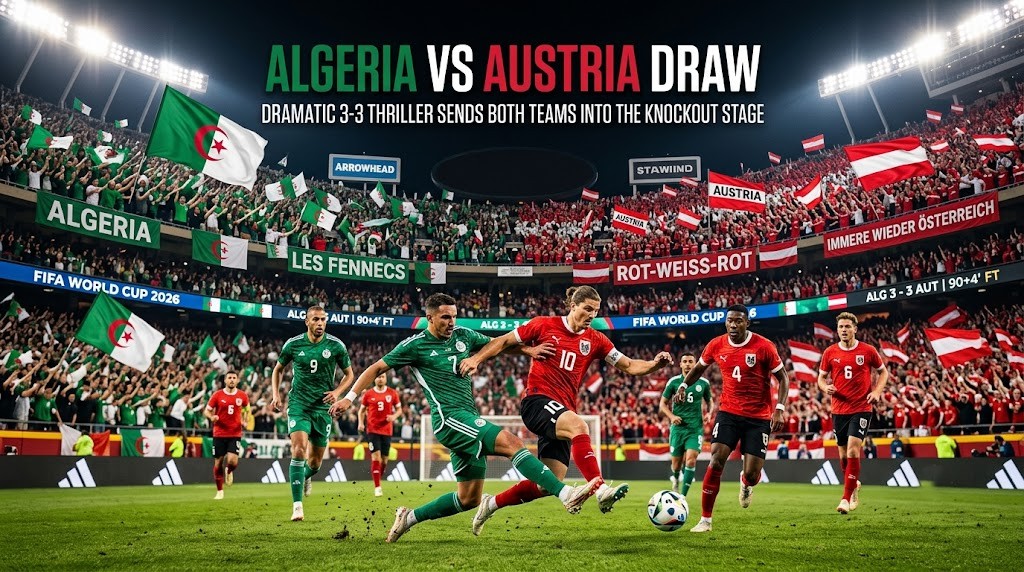
Algeria vs Austria Draw: Dramatic 3-3 Thriller Sends Both Teams Into the Knockout Stage – Algeria vs Austria draw 3-3 in one of the most dramatic matches of the 2026 FIFA World Cup group stage, securing qualification for both national teams while ending Iran’s hopes of reaching the Round of 32.
The decisive Group J encounter in Kansas City delivered six goals, repeated momentum changes, two stoppage-time strikes, and an unforgettable ending. Austria twice moved ahead, Algeria twice fought back, and Riyad Mahrez appeared to have scored a dramatic winning goal before substitute Sasa Kalajdzic headed home Austria’s equalizer in the 96th minute.
The final result allowed Austria to finish second in Group J, while Algeria advanced as one of the eight best third-place teams. Iran, which needed the match to produce a winner, was eliminated after Austria’s last-minute equalizer changed the qualification standings once again.
Algeria and Austria Advance After an Unforgettable 3-3 Draw
The final result was ideal for both Algeria and Austria, but the path toward qualification was anything but comfortable.
Austria finished second in Group J, behind defending world champion Argentina, and secured an automatic position in the Round of 32. Algeria progressed as one of the eight highest-ranked third-place teams from the tournament’s 12 groups.
For much of the evening, however, neither team looked fully secure.
Austria led twice, Algeria equalized twice, and both sides experienced moments when their tournament appeared to be under threat. Algeria then moved 3-2 ahead in stoppage time before Austria produced one final response.
The constantly changing scoreline transformed the qualification picture with almost every major attack. Supporters were not simply following one match. They were also calculating goal difference, third-place rankings, and possible knockout-stage opponents.
Iran, which had completed its three group games and was waiting to discover whether three points would be enough to advance, depended on the match producing a winner. A victory for either Algeria or Austria could have opened a path for Iran.
A draw, however, would place both Algeria and Austria ahead of Iran in the third-place calculations.
For approximately 90 minutes, Iran’s situation changed repeatedly. Mahrez’s late goal appeared to provide the decisive winner Iran needed. Seconds later, Kalajdzic’s equalizer reversed everything.
That dramatic conclusion made Algeria vs Austria one of the most consequential games of the group stage.
What Was at Stake Before Algeria vs Austria?
The qualification situation created an unusual atmosphere before kickoff.
Argentina had already established itself as the strongest team in Group J, while Algeria and Austria entered their final match with three points each. Tournament debutant Jordan was also completing its campaign against Argentina.
Under the expanded 48-team World Cup format, the top two teams from each group qualify automatically. In addition, the eight best third-place finishers across all 12 groups advance to the newly introduced Round of 32.
This format meant that Algeria and Austria were not competing only against each other. Algeria’s final position also had to be compared with third-place teams from other groups, including Iran.
A draw was likely to satisfy both sides. Austria would remain ahead of Algeria in the group standings, while Algeria would collect the additional point needed to improve its third-place ranking.
That created widespread discussion about whether the teams would play aggressively or settle for a controlled result.
The concerns were understandable. Tournament football has produced previous examples in which two teams recognized that a particular result benefited them both. When neither team has a strong incentive to take risks, a match can become cautious.
Algeria and Austria initially seemed trapped between ambition and calculation. They wanted to qualify, but they also knew that an unnecessary mistake could end their World Cup campaigns.
The eventual six-goal thriller proved that neither side was prepared to rely entirely on mathematics.
The Historical Shadow of the 1982 World Cup
No discussion of Algeria against Austria could ignore what happened at the 1982 FIFA World Cup.
That tournament produced one of the most controversial matches in football history. Algeria had shocked West Germany earlier in the competition and remained in contention for qualification before West Germany faced Austria in the final group game.
A narrow West German victory would send both European teams through while eliminating Algeria. West Germany scored early, and the two teams then played with little attacking urgency for the remainder of the match.
The 1-0 result produced exactly the qualification outcome that benefited West Germany and Austria.
The match became known as the “Disgrace of Gijón.” It caused widespread anger and helped convince football authorities to schedule the final group matches simultaneously at future World Cups.
Forty-four years later, Algeria and Austria met again in circumstances that inevitably revived memories of 1982.
This time, however, Algeria was one of the teams that could benefit from a draw. Supporters and commentators wondered whether history might return in a different form, with Algeria and Austria protecting a mutually advantageous score.
The comparison placed additional pressure on both teams. Every sideways pass could be interpreted as evidence of caution. Every period of reduced intensity could revive suspicions.
For a brief period after the score became 2-2, the pace did slow. Both teams recognized that the existing result would take them through. The crowd responded with whistles as possession became safer and attacks became less frequent.
Yet the final minutes destroyed any suggestion that the match had been arranged or deliberately controlled. Algeria attacked for a winner, Austria fought to respond, and the two teams exchanged goals during an extraordinary conclusion.
Rather than becoming another symbol of World Cup controversy, Algeria vs Austria became a demonstration of competitive chaos.
Austria Strike First Through Marko Arnautovic
The opening stages reflected the pressure surrounding the match.
Neither side immediately committed large numbers forward. Algeria attempted to establish possession, while Austria looked for opportunities to press and attack directly.
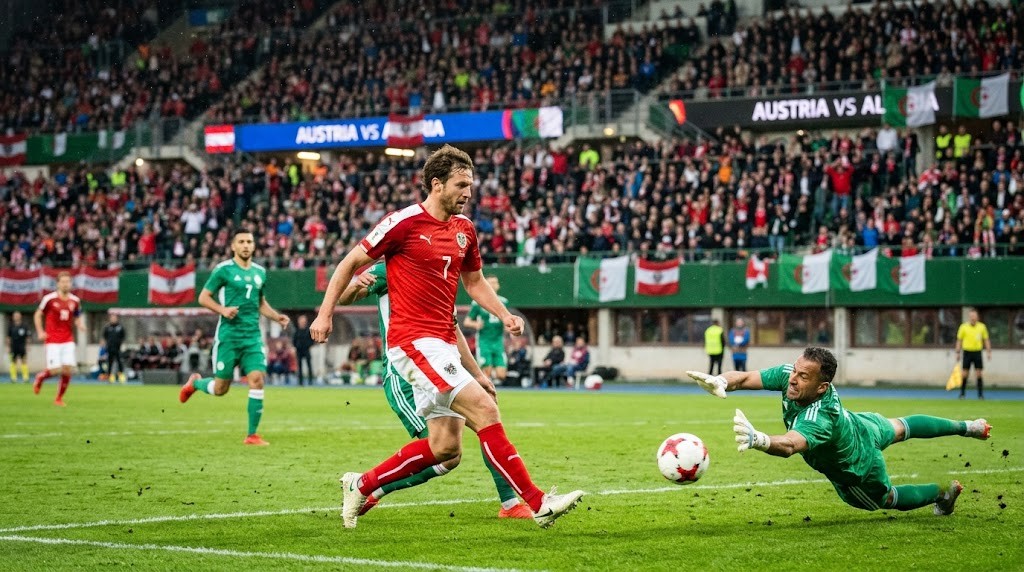
Austria’s breakthrough arrived in the 28th minute through experienced striker Marko Arnautovic.
David Alaba played an accurate long pass behind Algeria’s defensive line. Arnautovic timed his movement well and found himself running toward goalkeeper Oussama Benbot.
The Austrian forward’s first touch was not perfect, but Benbot hesitated as he came from his goal. Arnautovic recovered quickly and guided the ball beyond the goalkeeper.
It was the first shot on target of the game and a major moment for Austria.
Arnautovic’s goal gave Ralf Rangnick’s team greater control of the qualification situation. With the lead, Austria could protect its position and force Algeria to take more risks.
For Algeria, conceding first created immediate danger. A defeat would leave the North African side on three points and vulnerable in the third-place table.
The goal also highlighted Austria’s direct attacking threat. With players such as Alaba capable of delivering accurate passes from deep areas, Algeria could not afford to defend with an unorganized back line.
Arnautovic’s movement and experience were equally important. At 37, the striker remained capable of recognizing space and punishing hesitation.
Austria appeared to be moving toward halftime with the advantage, but Algeria gradually increased the pressure.
Rafik Belghali Produces a Spectacular Algerian Equalizer
Algeria nearly equalized when Fares Chaibi struck the post late in the first half.
That warning sign was followed by one of the finest individual moments of the match.
Riyad Mahrez helped keep the ball in play near the right side of Austria’s penalty area. Rafik Belghali reacted quickly, collected possession, and drove into the box.
The Algerian defender showed the confidence of an attacking winger. He moved past several Austrian players, maintained control under pressure, and fired a powerful finish into the top portion of the goal.
Goalkeeper Alexander Schlager had little chance.
Belghali’s equalizer changed the emotional direction of the match. Algeria had recovered before halftime and restored the result needed for qualification.
The goal also demonstrated Algeria’s determination to attack rather than simply wait for favorable circumstances elsewhere.
Belghali’s contribution was especially significant because it came from a right-back. Modern international football increasingly depends on defenders who can contribute in advanced areas, and Belghali’s willingness to continue the attack created a goal from a situation that initially appeared difficult.
Algeria entered halftime at 1-1 with renewed confidence.
Austria, meanwhile, had to reconsider its approach. Rangnick’s team had allowed Algeria to build momentum and could no longer assume that the first goal would be enough.
Ralf Rangnick Makes Changes at Halftime
Austria responded to Algeria’s late first-half pressure by making three substitutions at halftime.
The changes demonstrated that Rangnick was not satisfied with allowing the match to remain level. Instead of protecting the draw from the beginning of the second half, Austria attempted to regain control.
Rangnick’s football philosophy has traditionally emphasized pressing, physical intensity, vertical passing, and rapid transitions. Austria’s performance reflected many of those principles, although Algeria’s technical players repeatedly found ways to escape pressure.
The halftime adjustments helped Austria begin the second period more aggressively.
Algeria still carried a threat through Mahrez, Houssem Aouar, and its advancing full-backs, but Austria found space on the right and began moving the ball forward more quickly.
Ten minutes after the restart, Austria regained the lead.
Marcel Sabitzer Restores Austria’s Advantage
Austria’s second goal developed from a quick attacking move involving Konrad Laimer and Marcel Sabitzer.
Laimer advanced down the right side and created separation from the Algerian defense. His movement forced Algeria’s defenders toward the ball, opening space near the edge of the penalty area.
The pass arrived for Sabitzer, who finished with his first touch from approximately 18 meters.
The strike gave Austria a 2-1 lead in the 55th minute and again placed Algeria under pressure.
Sabitzer’s goal illustrated Austria’s ability to attack before Algeria could reorganize. Laimer’s speed and direct running created the opening, while Sabitzer’s positioning allowed him to arrive at the ideal moment.
The goal was also a reminder of the experience within Austria’s midfield. Sabitzer has played at the highest levels of European football and understood when to move into an attacking area without leaving his team exposed.
At 2-1, Austria appeared to have regained control. Its supporters were still celebrating when Algeria began constructing another response.
Only a few minutes separated Sabitzer’s goal from Algeria’s next equalizer.
Riyad Mahrez Responds for Algeria
Houssem Aouar played a central role in Algeria’s second goal.
The midfielder moved down the left and delivered a controlled cutback into an area where Mahrez had found space. Austria’s defenders were pulled toward Aouar, allowing Algeria’s captain to receive the ball with time to finish.
Mahrez curled his shot beyond Schlager and into the upper corner.
The goal made the score 2-2 and restored Algeria’s place in the qualification positions.
It was a classic Mahrez finish. The former Manchester City winger has built his career on calm decision-making, close control, and the ability to place shots beyond goalkeepers from difficult angles.
His equalizer was important not only because of the score but also because of the timing. Austria had barely completed its celebrations before Algeria responded.
That ability to recover became one of the defining features of Algeria’s performance. Vladimir Petkovic’s team conceded the first goal and equalized. It fell behind again and equalized again.
Algeria never allowed Austria to remain comfortable for long.
The match had produced four goals by the hour mark, yet the qualification situation encouraged both teams to become more cautious afterward.
A Temporary Drop in Intensity
Once the score reached 2-2, the character of the game changed.
For the first time, both teams had exactly what they needed. Austria was positioned to finish second, while Algeria was moving toward qualification as a third-place team.
Risk management became more important.
Instead of pressing constantly or committing players forward, Algeria and Austria began circulating possession more patiently. Some passes moved sideways or backward. Defenders avoided unnecessary challenges, and both teams appeared aware that one mistake could destroy their progress.
Supporters inside the stadium recognized the shift. Whistles could be heard as the tempo slowed.
The reaction reflected the historical context of the match. Because of the events of 1982, even a short period of caution attracted immediate suspicion.
However, cautious football is not automatically evidence of cooperation. With a place in the World Cup knockout stage at stake, protecting a favorable result is a normal tactical decision.
Both managers later acknowledged that there had been a passive period, but the final events proved that neither team had abandoned its desire to attack.
As the match entered its closing stages, fatigue created more space. Algeria’s attackers began finding opportunities, while Austria looked increasingly vulnerable when forced to defend deeper.
The contest was about to produce one of the most dramatic endings of the tournament.
Riyad Mahrez Scores in Stoppage Time
In the third minute of added time, Mahrez scored again.
The Algerian captain’s second goal appeared to be the winner.
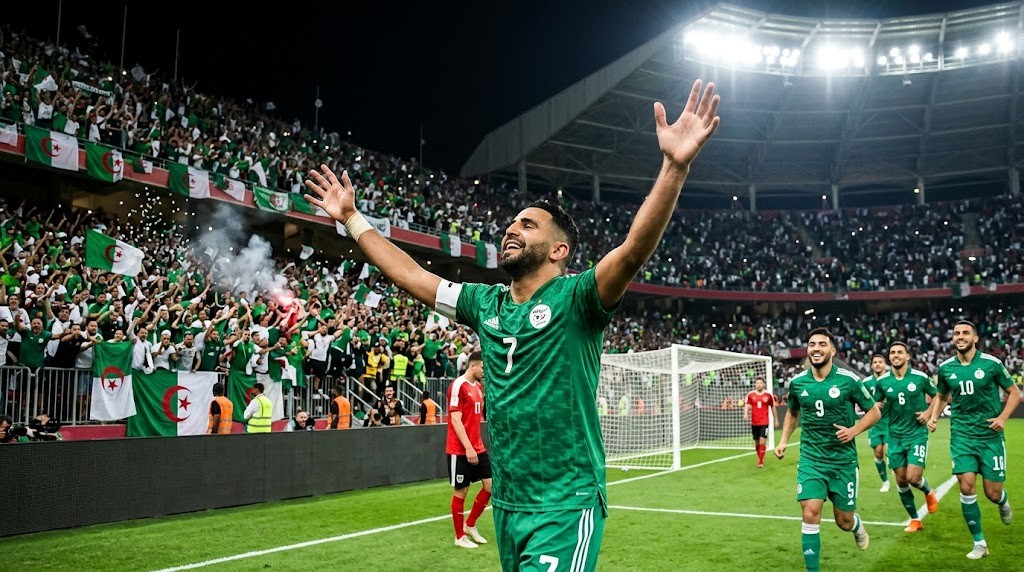
Algeria moved 3-2 ahead, triggering celebrations among the players, coaching staff, and supporters. After twice recovering from losing positions, Algeria had finally taken the lead.
For Austria, the goal was devastating. A match that had seemed safely under control at 2-2 had suddenly become a defeat.
The goal also transformed the wider third-place ranking.
Iran, watching from a distance after completing its group-stage schedule, appeared to have received the result it needed. If the match ended with an Algerian victory, Austria’s points and goal difference could have fallen below Iran in the race for the final knockout places.
For several seconds, Mahrez’s goal seemed to have changed the tournament journeys of three nations.
Algeria was on course for a famous victory. Iran was moving toward an unlikely qualification. Austria was approaching elimination.
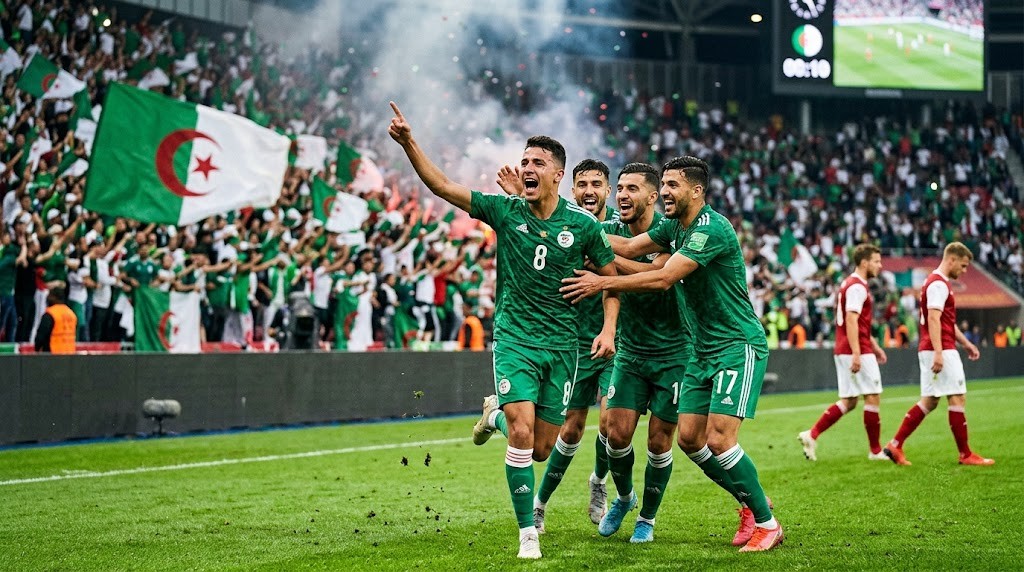
Mahrez celebrated what he believed would be the decisive moment. His teammates gathered around him, and Algerian supporters produced an explosion of noise.
Yet Austria still had one final opportunity.
Sasa Kalajdzic’s 96th-Minute Header Changes Everything
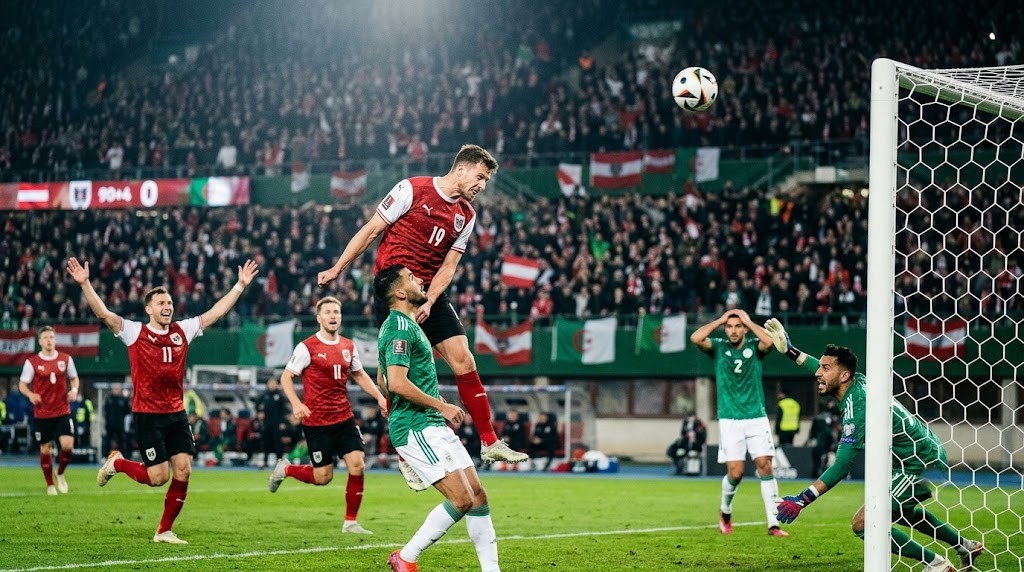
Austria responded by introducing Sasa Kalajdzic.
The striker had only just entered the match when he became the central figure in its most dramatic moment.
Austria sent a long ball into Algeria’s defensive area. With time almost finished, there was no reason to construct a patient attack. The objective was simple: move the ball forward and give the tallest players an opportunity.
The first header kept the attack alive. Kalajdzic then rose and directed the ball into the goal.
The equalizer arrived in the 96th minute, with almost the final touch of the game.
Austria’s players celebrated wildly. Algeria’s players initially experienced disappointment after losing their lead, but the final whistle soon confirmed that the draw was enough for both teams.
The goal was remarkable for several reasons.
First, Kalajdzic had been on the field for only seconds. He entered with a clear role and immediately completed it.
Second, the equalizer came after regulation time had effectively expired. Austria had one final attack and converted it.
Third, the goal changed the identity of the final third-place qualifier. Iran moved from apparent qualification to elimination almost instantly.
Football tournaments often turn on fine margins. In Kansas City, those margins were measured in seconds.
Why the 3-3 Draw Eliminated Iran
Iran completed Group G with three points after drawing all three of its matches.
The team had not been officially eliminated when its final game ended because the ranking of third-place teams depended on results from other groups.
Under the 2026 World Cup format, eight of the 12 third-place teams qualify for the Round of 32. Teams are separated by points and then by tiebreaking criteria such as goal difference and goals scored.
Iran therefore had to wait for the remaining group-stage fixtures.
The Algeria-Austria match became decisive. If either team won, the losing side might remain on three points and potentially fall below Iran.
When Mahrez scored to make it 3-2, Iran’s path appeared to have opened.
Kalajdzic’s equalizer closed it again.
The draw increased both Algeria and Austria’s totals to four points, placing them safely above Iran. Austria qualified as the Group J runner-up, while Algeria secured a place among the best third-place teams.
Iran finished one position outside the qualification places.
The elimination was particularly painful because Iran had avoided defeat in all three matches. However, three draws produced only three points, leaving the team dependent on other results.
The situation demonstrated one of the unusual features of the expanded tournament. A team’s fate can be determined by a match involving two countries from a completely different group.
Iran’s players were no longer able to influence the outcome. They could only watch as Austria and Algeria decided their future.
Algeria’s Fighting Spirit Earns a Knockout Place
Algeria’s qualification was built on resilience.
Petkovic’s side entered the final group match under pressure and then fell behind twice. On both occasions, Algeria responded quickly enough to prevent Austria from controlling the game.
Belghali’s first-half equalizer provided belief, while Mahrez’s two goals demonstrated the importance of experienced leaders in tournament football.
Mahrez was central to almost everything Algeria created. He helped keep the attack alive before Belghali’s goal, scored the second equalizer, and appeared to win the match in stoppage time.
Although Algeria could not protect the 3-2 lead, qualification remained the primary objective.
The performance also showed Algeria’s technical quality. Aouar carried the ball effectively, Belghali attacked from defense, and Mahrez repeatedly found dangerous positions.
Defensively, Algeria was less convincing. The team struggled with Austria’s direct passing, Laimer’s movement, and aerial balls near the end of the match.
Those weaknesses will require attention in the knockout stage, where one defensive mistake can end a tournament.
Nevertheless, Algeria demonstrated a mentality that could make the team a difficult opponent. Petkovic’s players did not collapse after conceding, and they continued searching for opportunities even when the draw was enough.
Qualification represents another important chapter in Algeria’s World Cup history.
Austria Reach the Knockout Stage After a Long Wait
Austria’s progression was historically significant.
The country had not advanced beyond the group stage of a World Cup since 1982. Its most recent appearance before 2026 had come in 1998, when it was eliminated in the opening round.
The 2026 campaign therefore marked Austria’s return to the global stage after a long absence.
Rangnick has developed a team based on intensity, organization, and collective movement. Austria entered the tournament with growing confidence after strong performances in European competition.
The draw against Algeria revealed both the strengths and weaknesses of Rangnick’s team.
Austria created goals through direct passes, aggressive runs, and intelligent midfield movement. Alaba’s distribution, Laimer’s energy, Sabitzer’s finishing, and Arnautovic’s experience all played important roles.
At the same time, Austria struggled to control the game after taking the lead. Algeria equalized twice during periods when Rangnick’s team dropped deeper and allowed its opponent to advance.
The late goal conceded to Mahrez was another warning.
However, Austria’s response demonstrated exceptional belief. Many teams would have accepted elimination after falling behind in stoppage time. Austria immediately pushed forward and produced the equalizer.
Kalajdzic’s header ensured that Austria’s World Cup journey would continue.
Tactical Analysis: Austria’s Direct Approach
Austria’s attacking plan frequently depended on vertical football.
Rather than attempting to dominate possession through long passing combinations, Rangnick’s side looked for moments when it could play beyond Algeria’s midfield.
Alaba’s pass for Arnautovic’s opener was a perfect example. The defender recognized the striker’s movement and delivered the ball before Algeria could recover.
Laimer also created problems with his ability to carry possession forward quickly. His run before Sabitzer’s goal forced Algeria to defend while moving toward its own penalty area.
This direct approach was especially effective when Algeria pushed its full-backs forward. Austria could attack the space left behind them before the defensive structure was restored.
However, the strategy also carried risks.
When Austria lost possession after sending players forward, Mahrez and Aouar had space to counterattack. Algeria’s second goal developed from a rapid move down the left, an area Austria had not protected effectively.
Austria’s pressing was strong in certain periods but inconsistent across the entire match. The humid conditions and emotional intensity made it difficult to maintain pressure for 90 minutes.
When the pressing weakened, Algeria’s technical players gained greater influence.
Against Spain in the Round of 32, Austria will need to decide when to press and when to defend in a compact shape. Spain’s ability to retain possession could punish an uncoordinated press.
Tactical Analysis: Algeria’s Width and Individual Creativity
Algeria’s attack relied heavily on width, overlapping runs, and individual skill.
Mahrez remained the primary creative figure on the right. Even when he was not shooting, his presence attracted defenders and created space for teammates.
Belghali’s goal demonstrated the value of Algeria’s full-backs advancing into attacking positions. He reacted to a loose ball, continued his run, and produced a finish more commonly associated with an elite forward.
On the opposite side, Aouar’s movement created the second goal. By carrying the ball toward the byline, he forced Austria’s defense to turn toward its own goal. His cutback gave Mahrez the ideal shooting angle.
Algeria often looked most dangerous when attacking quickly rather than circulating possession slowly.
Austria’s defensive shape was organized when given time to prepare. It became less secure when Algeria increased the tempo and moved the ball into wide areas.
Petkovic’s team also showed confidence in one-on-one situations. Belghali and Mahrez were willing to challenge defenders rather than immediately recycle possession.
However, Algeria’s attacking ambition sometimes left the defense exposed. Austria repeatedly found space for long passes, and the final equalizer came from an aerial situation that Algeria failed to control.
The next challenge against Switzerland will require a better balance between attacking numbers and defensive security.
The Importance of Experienced Players
The match was strongly influenced by experienced international players.
Arnautovic, Alaba, Sabitzer, Mahrez, Aouar, and Kalajdzic all contributed to major moments.
Arnautovic’s movement created Austria’s first goal. Alaba’s passing supplied it. Sabitzer arrived from midfield to score the second. Kalajdzic used his height and positioning to rescue the draw.
For Algeria, Mahrez led the attack with two goals and an important role in the first equalizer.
Tournament football often places extraordinary pressure on players. Teams have little time to recover from mistakes, and a single decision can change their future.
Experienced players are valuable because they have faced similar emotional situations before. They understand when to slow the game, when to take risks, and how to remain calm in front of goal.
Mahrez’s finishes demonstrated that composure. Kalajdzic’s header showed the ability to make an immediate impact despite entering the game under extreme pressure.
The match also proved that experience does not eliminate unpredictability. Even the most established players were involved in a contest that changed direction repeatedly.
What the Match Says About the Expanded World Cup
The 2026 FIFA World Cup is the first edition to include 48 teams.
The expanded format created 12 groups of four, with 32 nations advancing to the knockout stage. That means some third-place teams progress, while others are eliminated through comparisons across different groups.
Supporters of the format argue that it gives more countries an opportunity to participate and keeps more teams involved until the final group matches.
The Algeria-Austria drama supports that argument. Both teams remained alive, Iran remained interested despite completing its games, and the final qualification place was not decided until the last seconds.
Critics, however, identify several problems.
Teams can be forced to wait for results from other groups. Not every third-place team plays under identical circumstances. Countries completing their schedule later may know exactly what result they need.
The possibility of a mutually beneficial draw also creates concerns about competitive integrity.
Algeria and Austria ultimately delivered a genuine contest, but the pre-match debate showed that the format can produce uncomfortable situations.
The match was therefore both a celebration of the expanded World Cup and a warning about its complications.
More teams created more drama, but they also created more complex qualification calculations.
The Emotional Contrast After the Final Whistle
The final whistle produced contrasting emotions.
Austria’s players celebrated Kalajdzic’s equalizer as though it were a victory. After believing their tournament might be ending, they had recovered with the last meaningful attack.
Algeria’s players experienced a more complicated reaction. They had been seconds away from winning but quickly recognized that the draw had achieved their main objective.
Both sets of supporters celebrated qualification.
Elsewhere, Iran faced disappointment. Its players had completed an unbeaten group-stage campaign but were eliminated by a goal scored in another city, in another group, after their own schedule had ended.
That emotional contrast is part of what makes World Cup football so powerful.
The same goal can create joy for two countries and heartbreak for another.
Kalajdzic’s header did not simply change the score from 3-2 to 3-3. It altered travel plans, knockout pairings, national expectations, and the careers of players and coaches.
What Comes Next for Austria?
Austria will face Spain in the Round of 32.
The matchup presents a significant tactical challenge.
Spain is traditionally comfortable controlling possession and forcing opponents to defend for long periods. Austria will need to remain compact while identifying opportunities to press.
Rangnick’s side cannot afford to repeat the defensive lapses seen against Algeria. Spain is likely to punish space between the midfield and defensive lines.
Austria’s direct attacking ability could still create opportunities. Alaba’s passing and Laimer’s running may be valuable if Spain commits players forward.
Set pieces and aerial attacks could also offer Austria a route toward goal. Kalajdzic’s dramatic equalizer demonstrated the threat provided by Austria’s taller forwards.
Austria will enter the knockout match as an underdog, but reaching this stage has already ended a long period of World Cup frustration.
The team’s refusal to surrender against Algeria should provide confidence.
What Comes Next for Algeria?
Algeria will meet Switzerland in the Round of 32.
Switzerland has developed a reputation as an organized and disciplined tournament team. Algeria will need patience to break down a compact defense.
Mahrez’s creativity will again be important, but Algeria cannot depend entirely on its captain.
Aouar, Belghali, Chaibi, and the team’s other attacking options must continue creating opportunities from different areas.
Defensive concentration will be equally essential. Switzerland is capable of exploiting mistakes and is experienced in close knockout matches.
Algeria’s ability to recover against Austria suggests that the team will not panic if it concedes. However, relying on repeated comebacks is dangerous.
Petkovic will want his players to maintain their attacking confidence while improving their organization without the ball.
Algeria’s supporters can take encouragement from the team’s spirit. After missing recent World Cups, returning to the knockout stage represents an important achievement.
Why Algeria vs Austria Will Be Remembered
Many World Cup group games are forgotten soon after the tournament ends.
Algeria vs Austria is unlikely to be one of them.
The match contained six goals, two comebacks, a late apparent winner, an even later equalizer, historical tension, and a direct effect on another nation’s elimination.
It also challenged the assumptions made before kickoff.
A match that many feared would become a cautious draw instead developed into a chaotic attacking contest.
Mahrez appeared to have written the final chapter in the 93rd minute. Kalajdzic rewrote it three minutes later.
The historical link to 1982 adds further significance. Algeria and Austria were once connected by one of the World Cup’s most controversial stories. In 2026, they produced a match defined by competition rather than cooperation.
The result suited both countries, but it was not achieved safely.
Both teams had to survive moments when qualification seemed to be disappearing.
Final Thoughts on the Algeria vs Austria Draw
The 3-3 draw between Algeria and Austria captured everything that makes the World Cup compelling.
It combined tactics, history, pressure, individual brilliance, national pride, and unpredictable drama.
Austria twice took the lead through Arnautovic and Sabitzer. Algeria twice responded through Belghali and Mahrez. Mahrez then scored again in stoppage time, seemingly giving Algeria victory and Iran a place in the knockout stage.
Kalajdzic’s 96th-minute header changed the outcome one final time.
Austria advanced as the runner-up in Group J. Algeria qualified as one of the best third-place teams. Iran was eliminated.
For Austria, the result ended a wait of more than four decades for a place beyond the World Cup group stage. For Algeria, it marked another proud knockout qualification and an opportunity to continue its campaign against Switzerland.
The teams may face much greater challenges in the Round of 32, but their meeting in Kansas City has already earned a place among the defining games of the 2026 tournament.
It was a draw that felt like a victory for two nations and a defeat for a third.
More importantly, it was a reminder that no qualification calculation is final until the referee blows the whistle.
Frequently Asked Questions
What was the final score between Algeria and Austria?
Algeria and Austria drew 3-3 in their final Group J match at the 2026 FIFA World Cup.
Who scored for Austria against Algeria?
Marko Arnautovic, Marcel Sabitzer, and Sasa Kalajdzic scored Austria’s three goals.
Who scored for Algeria against Austria?
Rafik Belghali scored Algeria’s first goal, while captain Riyad Mahrez scored twice.
When did Sasa Kalajdzic score the equalizer?
Kalajdzic headed in Austria’s equalizer in the 96th minute, shortly after entering the game as a substitute.
Did Algeria qualify for the World Cup knockout stage?
Yes. Algeria qualified for the Round of 32 as one of the tournament’s best third-place teams.
Did Austria qualify for the Round of 32?
Yes. Austria finished second in Group J and advanced automatically to the knockout stage.
Why was Iran eliminated?
Iran finished the group stage with three points and needed the Algeria-Austria match to produce a winner. The 3-3 draw placed both Algeria and Austria above Iran in the qualification rankings.
Who will Austria play in the Round of 32?
Austria will face Spain in the first knockout round.
Who will Algeria play next?
Algeria will face Switzerland in the Round of 32.
Why was the Algeria-Austria match compared with the 1982 World Cup?
In 1982, West Germany defeated Austria 1-0 in a controversial match that allowed both European teams to qualify while eliminating Algeria. Because a draw in the 2026 Algeria-Austria match benefited both countries, the historical comparison returned before kickoff.
Was the Algeria-Austria draw arranged?
There is no evidence that the result was arranged. The match featured aggressive attacking play, six goals, multiple changes of lead, and two goals in stoppage time.
Is this Austria’s first World Cup knockout appearance?
It was Austria’s first qualification beyond the World Cup group stage since the 1982 tournament.
When did Algeria last reach the World Cup knockout stage?
Before 2026, Algeria most recently reached the knockout stage in 2014, when it advanced to the Round of 16.
How does third-place qualification work at the 2026 World Cup?
The top two teams from each of the 12 groups qualify automatically. The eight best third-place teams also advance, creating a 32-team knockout stage.
Why was the 3-3 draw so important?
The result secured qualification for both Algeria and Austria, eliminated Iran, determined two Round of 32 matchups, and produced one of the most dramatic endings of the tournament.
Home Page: Makvera.com